
Motorway Rules
You’re on a motorway. A red cross is displayed above the hard shoulder. What does this mean?
Active traffic management operates on some motorways. Within these areas, at certain times, the hard shoulder will be used as a running lane. A red cross above the hard shoulder shows that this lane should only be used for emergencies and breakdowns.
What should you do when driving or riding along a motorway?
Traffic on motorways usually travels faster than on other roads. You need to be looking further ahead to give yourself more time to react to any hazard that may develop.
You’re travelling along a motorway. When are you allowed to overtake on the left?
Never overtake on the left, unless the traffic is moving in queues and the queue on your right is moving more slowly than the one you’re in.
Your car gets a puncture while you’re driving on the motorway. You get it onto the hard shoulder. What should you do?
Park as far to the left as you can and leave the vehicle by the nearside door. Don’t attempt even simple repairs. Instead, walk to an emergency telephone on your side of the road and phone for help. While waiting for help to arrive, stay by your car, keeping well away from the carriageway and hard shoulder.
You’re travelling in the left-hand lane of a three-lane motorway. How should you react to traffic joining from a slip road?
Plan well ahead when approaching a slip road. If you see traffic joining the motorway, move to another lane if it’s safe to do so. This can help the flow of traffic joining the motorway, especially at peak times.
What should the left-hand lane of a motorway be used for?
You should drive in the left-hand lane whenever possible. Only use the other lanes for overtaking or when directed to do so by signals. Using other lanes when the left-hand lane is empty can frustrate drivers behind you.
What should you do when going through a contraflow system on a motorway?

At roadworks, and especially where a contraflow system is operating, a speed restriction is likely to be in place. Keep to the lower speed limit and don’t switch lanes or get too close to the vehicle in front of you. Be aware that there will be no permanent barrier between you and the oncoming traffic.
You’ve broken down on a motorway. In which direction should you walk to find the nearest emergency telephone?
Along the hard shoulder there are marker posts at 100-metre intervals. These will direct you to the nearest emergency telephone.
Advertisement
ArrayWhen may you stop on the hard shoulder of a motorway?

You should only stop on the hard shoulder in a genuine emergency. Don’t stop there to have a rest or picnic, pick up hitchhikers, answer a mobile phone or check a map. If you miss your intended exit, carry on to the next. Never reverse along the hard shoulder.
You’re travelling along a motorway. Where would you find a crawler or climbing lane?
Large, slow-moving vehicles can hinder the progress of other traffic. On a steep gradient, an extra crawler lane may be provided for slow-moving vehicles to allow faster-moving traffic to flow more easily.
You’re on a motorway. What colour are the reflective studs on the left of the carriageway?
Red studs are placed between the edge of the carriageway and the hard shoulder. Where slip roads leave or join the motorway, the studs are green.
When may you stop on a motorway?
You shouldn’t normally stop on a motorway, but there may be occasions when you need to do so. If you’re unfortunate enough to break down, make every effort to pull up on the hard shoulder.
You’re driving on a motorway. The car in front shows its hazard warning lights for a short time. What does this tell you?
If the vehicle in front shows its hazard warning lights, there may be an incident, stopped traffic or queuing traffic ahead. By keeping a safe distance from the vehicle in front, you’re able to look beyond it and see any hazards well ahead.
You’re travelling along a motorway and feel tired. Where should you stop to rest?
If you feel tired, stop at the nearest service area. If that’s too far away, leave the motorway at the next exit and find a safe place to stop. You mustn’t stop on the carriageway or hard shoulder of a motorway except in an emergency, when in a traffic queue, or when signalled to do so by a police officer, a traffic officer or traffic signals. Plan your journey so that you have regular rest stops.
You’re driving on a motorway. By mistake, you go past the exit that you wanted to take. What should you do?
It’s illegal to reverse, cross the central reservation or drive against the traffic flow on a motorway. If you miss your exit, carry on until you reach the next one. Ask yourself why you missed your exit
What should you do when you’re joining a motorway?
You should give way to traffic already on the motorway. Where possible, traffic may move over to let you in, but don’t force your way into the traffic stream. Traffic could be travelling at high speed, so try to match your speed to filter in without affecting the traffic flow.
You’ve had a breakdown on the hard shoulder of a motorway. When the problem has been fixed, how should you rejoin the main carriageway?
Signal your intention and build up sufficient speed on the hard shoulder so that you can filter into a safe gap in the traffic. Don’t push your way in, causing other traffic to alter speed or direction.
On which part of a motorway are amber reflective studs found?
On motorways, reflective studs of various colours are fixed in the road between the lanes. These help you to identify which lane you’re in when it’s dark or in poor visibility. Amber-coloured studs are found on the right-hand edge of the main carriageway, next to the central reservation.
What colour are the reflective studs between a motorway and its slip road?
The studs between the carriageway and the hard shoulder are normally red. These change to green where there’s a slip road, helping you to identify slip roads when visibility is poor or when it’s dark.
What should you do immediately after joining a motorway?
Stay in the left-hand lane long enough to get used to the higher speeds of motorway traffic before considering overtaking.
You shouldn’t normally travel on the hard shoulder of a motorway. When can you use it?
Normally, you should only use the hard shoulder for emergencies and breakdowns, and at roadworks when signs direct you to do so. Smart motorways use active traffic management to ease traffic congestion. In these areas, the hard shoulder may be used as a running lane when speed-limit signs are shown directly above.
What’s the national speed limit on motorways for cars and motorcycles?
Travelling at the national speed limit doesn’t allow you to hog the right-hand lane. Always use the left-hand lane whenever possible. When leaving a motorway, get into the left-hand lane well before your exit. Reduce your speed on the slip road and look out for sharp bends or curves and traffic queuing at roundabouts.
Which of these isn’t allowed to travel in the right-hand lane of a three-lane motorway?
A vehicle with a trailer is restricted to 60 mph. For this reason, it isn’t allowed in the right-hand lane, as it might hold up faster-moving traffic that wishes to overtake in that lane.
Your vehicle has broken down on a motorway. You aren’t able to stop on the hard shoulder. What should you do?
If you can’t get your vehicle onto the hard shoulder, use your hazard warning lights to warn others. Leave your vehicle only when you can safely get clear of the carriageway. Don’t try to repair the vehicle or attempt to place any warning device on the carriageway.
You’re on a three-lane motorway. There are red reflective studs on your left and white ones to your right. Which lane are you in?

The colours of the reflective studs on the motorway and their locations are red
You’re towing a trailer along a three-lane motorway. When may you use the right-hand lane?
If you’re towing a caravan or trailer, you mustn’t use the right-hand lane of a motorway with three or more lanes except in certain specified circumstances, such as when lanes are closed.
You’re on a motorway. There’s a contraflow system ahead. What would you expect to find?

When approaching a contraflow system, reduce speed in good time and obey all speed limits. You may be travelling in a narrower lane than normal, with no permanent barrier between you and the oncoming traffic. Be aware that the hard shoulder may be used for traffic and the road ahead could be obstructed by slow-moving or broken-down vehicles.
Unless signs show otherwise, what’s the national speed limit for a car or motorcycle on a motorway?
The national speed limit for a car or motorcycle on a motorway is 70 mph. Lower speed limits may be in force; for example, at roadworks. Variable speed limits also operate in some areas when the motorway is very busy. Cars or motorcycles towing trailers are subject to a lower speed limit.
You’re approaching roadworks on a motorway. What should you do?
Collisions often happen at roadworks. Be aware of the speed limits, slow down in good time and keep your distance from the vehicle in front.
You’re on a smart motorway. A mandatory speed limit is displayed above the hard shoulder. What does this mean?

A mandatory speed-limit sign above the hard shoulder shows that this part of the road can be used as a running lane between junctions. You must stay within the speed limit. Look out for vehicles that may have broken down and could be blocking the hard shoulder.
What colour are the reflective studs between the lanes on a motorway?

White studs are found between the lanes on motorways. They reflect back the light from your headlights. This is especially useful in bad weather, when visibility is restricted.
You’re towing a trailer on a motorway. What’s the speed limit for a car towing a trailer on this road?
Don’t forget that you’re towing a trailer. If you’re towing a small, light trailer, it won’t reduce your vehicle’s performance by very much. However, strong winds or buffeting from large vehicles might cause the trailer to snake from side to side. Be aware of your speed and don’t exceed the reduced speed limit imposed on vehicles towing trailers.
What should you use the hard shoulder of a motorway for?

Don’t use the hard shoulder for stopping unless it’s an emergency. If you want to stop for any other reason, go to the next exit or service station.
You’re using a smart motorway. What happens when it’s operating?
When a smart motorway is operating, you must follow the mandatory signs on the gantries above each lane, including the hard shoulder. Variable speed limits help keep the traffic moving and also help to prevent bunching.
Your vehicle breaks down on the hard shoulder of a motorway. You need to use your mobile phone to call for help. What should you do?
You should use an emergency telephone when you break down on the motorway; only use your mobile if this isn’t possible. The emergency services need to know your exact location so they can reach you as quickly as possible. Look for a number on the nearest marker post beside the hard shoulder. Give this number when you call the emergency services.
You’re on a three-lane motorway. A red cross is showing above the hard shoulder and mandatory speed limits above all other lanes. What does this mean?

A red cross above the hard shoulder shows that it’s closed as a running lane and should only be used for emergencies or breakdowns. On a smart motorway, the hard shoulder may be used as a running lane at busy times. This will be shown by a mandatory speed limit on the gantry above the hard shoulder.
You’re driving on the motorway. Well before you reach your intended exit, where should you position your vehicle?
You’ll see the first advance direction sign one mile from a motorway exit. If you’re travelling at 60 mph in the right-hand lane, you’ll only have about 50 seconds before you reach the countdown markers. There’ll be another sign at the half-mile point. Move to the left-hand lane in good time. Don’t cut across traffic at the last moment and don’t risk missing your exit.
What’s the right-hand lane used for on a three-lane motorway?
You should keep to the left and only use the right-hand lane if you’re passing slower-moving traffic.
You’re driving on a motorway and have to slow down quickly due to a hazard ahead. How can you warn drivers behind of the hazard?
Using your hazard warning lights, as well as your brake lights, will give following traffic an extra warning of the problem ahead. Only use them for long enough for your warning to be seen.
What do these motorway signs show?

The exit from a motorway is indicated by countdown markers. These are positioned 90 metres (100 yards) apart, the first being 270 metres (300 yards) from the start of the slip road. Move into the left-hand lane well before you reach the start of the slip road.
You are joining a motorway. Why is it important to make full use of the slip road?
Try to join the motorway without affecting the progress of the traffic already travelling on it. Always give way to traffic already on the motorway. At busy times you may have to slow down to merge into slow-moving traffic.
What’s used to reduce traffic bunching on a motorway?
Congestion can be reduced by keeping traffic at a constant speed. At busy times, maximum speed limits are displayed on overhead gantries. These can be varied quickly, depending on the amount of traffic. By keeping to a constant speed on busy sections of motorway, overall journey times are normally improved.
Traffic officers operate on motorways and some primary routes in England. What are they authorised to do?
Traffic officers don’t have enforcement powers but are able to stop and direct people on motorways and some ‘A’ class roads. They only operate in England and work in partnership with the police at incidents, providing a highly trained and visible service. They’re recognised by an orange-and-yellow jacket and their vehicle has yellow-and-black markings.
When are you allowed to stop on a motorway?
You must stop if overhead gantry signs show flashing red lights above every lane on the motorway. If any of the other lanes doesn’t show flashing red lights or a red cross, you may move into that lane and continue if it’s safe to do so.
On a motorway, what’s an emergency refuge area used for?
Emergency refuge areas are built at the side of the hard shoulder. If you break down, try to get your vehicle into the refuge, where there’s an emergency telephone. The phone connects directly to a control centre. Remember to take care when rejoining the motorway, especially if the hard shoulder is being used as a running lane.
What restrictions apply to new drivers holding a provisional driving licence?
New driver can drive on motorway under new rule,but with driving instructor. without driving instructor you cant drive on motorway or you cant take lessons on motorway.
You’re in the right-hand lane of a three-lane motorway. What do these overhead signs mean?

You must obey these signs even if there appear to be no problems ahead. There could be queuing traffic or another hazard which you can’t yet see.
How should you use the emergency telephone on a motorway?
Traffic is passing you at speed. If the draught from a large lorry catches you by surprise, it could blow you off balance and even onto the carriageway. By facing the oncoming traffic, you can see approaching lorries and so be prepared for their draught. You’ll also be in a position to see other hazards approaching.
On a three-lane motorway, what does this sign mean?

You must obey mandatory speed-limit signs above motorway lanes, including the hard shoulder. In this case, you can use the hard shoulder as a running lane but you should look for any vehicles that may have broken down and may be blocking the hard shoulder.
Which vehicles should use the left-hand lane on a three-lane motorway?
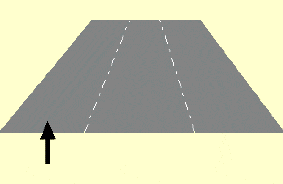
On a motorway, all traffic should use the left-hand lane unless overtaking. When overtaking a number of slower vehicles, move back to the left-hand lane when you’re safely past. Check your mirrors frequently and don’t stay in the middle or right-hand lane if the left-hand lane is free.
Why is it particularly important to carry out a check on your vehicle before making a long motorway journey?
Before you start your journey, make sure that your vehicle can cope with the demands of high-speed driving. You should check a number of things, the main ones being oil, water and tyres. You also need to plan rest stops if you’re making a long journey.
You break down on a motorway. You need to call for help. Why may it be better to use an emergency roadside telephone rather than a mobile phone?
On a motorway, it’s best to use a roadside emergency telephone so that the emergency services are able to find you easily. The location of the nearest telephone is shown by an arrow on marker posts at the edge of the hard shoulder. If you use a mobile, the operator will need to know your exact location. Before you call, find out the number on the nearest marker post. This number will identify your exact location.
You’re on a motorway and there are red flashing lights above every lane. What must you do?
Red flashing lights above all lanes mean you must stop and wait. You’ll also see a red cross lit up. Don’t change lanes, don’t continue and don’t pull onto the hard shoulder (unless in an emergency).
On a three-lane motorway, which lane should you normally use?
On a three-lane motorway, you should travel in the left-hand lane unless you’re overtaking. This applies regardless of the speed at which you’re travelling.
What’s the aim of a smart motorway?
Smart motorway schemes are intended to reduce congestion and make journey times more reliable. In these areas, the hard shoulder may be used as a running lane to ease congestion at peak times or in the event of an incident. Variable speed limits are used to help keep the traffic moving and to avoid bunching.
What basic rule applies when you’re using a motorway?
You should normally travel in the left-hand lane unless you’re overtaking a slower-moving vehicle. When you’ve finished overtaking, move back into the left-hand lane, but don’t cut across in front of the vehicle that you’ve overtaken.
Why can it be an advantage for traffic speed to stay constant over a longer distance?
When traffic travels at a constant speed over a longer distance, journey times normally improve. You may feel that you could travel faster for short periods, but this generally leads to bunching and increased overall journey time.
Share your Results: