
Other Types Of Vehicle
You should take extra care when you first encounter trams. You’ll have to get used to dealing with a different traffic system. Be aware that trams can accelerate and travel very quickly, and they can’t change direction to avoid obstructions.
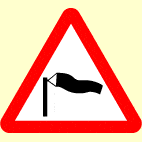
Although cars are the least likely to be affected, side winds can take anyone by surprise. This is most likely to happen after overtaking a large vehicle, when passing gaps between hedges or buildings, and on exposed sections of road.
Towing a large trailer or caravan can greatly reduce your view of the road behind. You may need to fit extended-arm side mirrors so that you can see clearly behind and down both sides of the caravan or trailer.
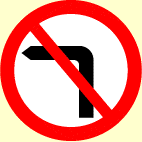
Hold back and wait until the vehicle has turned before proceeding. Don’t overtake, because the vehicle turning left could hide a vehicle emerging from the same junction.
Windy weather affects motorcyclists more than other vehicles. In windy conditions, high-sided vehicles cause air turbulence. You should keep well back, as the motorcyclist could be blown off course.
As you approach, look out for any signal the driver might make. If you pass the vehicle, watch out for pedestrians attempting to cross the road from behind the bus. They’ll be hidden from view until the last moment.
Some powered wheelchairs and mobility scooters are designed for use on the pavement only and cannot exceed 4 mph (6 km/h). Others can go on the road as well, and this category cannot exceed 8 mph (12 km/h). Take great care around these vehicles. They’re extremely vulnerable because of their low speed and small size.
When turning, long vehicles need much more room on the road than other vehicles. At junctions, they may take up the whole of the road space, so be patient and allow them the room they need.
Advertisement When a long vehicle is going to turn right, it may need to keep close to the left-hand kerb. This is to prevent the rear end of the trailer cutting the corner. You need to be aware of how long vehicles behave in such situations. Don’t overtake the lorry, because it could turn as you’re alongside. Stay behind and wait for it to turn.
There might be pedestrians crossing from in front of the bus. Look out for them if you intend to pass. Consider how many people are waiting to get on the bus – check the queue if you can. The bus might move off straight away if no-one is waiting to get on. If a bus is signalling to pull out, give it priority if it’s safe to do so.
Large vehicles can hide other vehicles that are overtaking
Large vehicles throw up a lot of spray when it’s wet. This makes it difficult for following drivers to see the road ahead. You’ll be able to see more by dropping back further, out of the spray. This will also increase your separation distance, giving you more room to stop if you have to.
At mini-roundabouts, there isn’t much room for a long vehicle to manoeuvre. It will have to swing out wide so that it can complete the turn safely. Keep well back and don’t try to move up alongside it.
Sometimes, large vehicles may need more space than other road users. If a vehicle needs more time and space to turn, be prepared to stop and wait.
In windy weather, watch out for motorcyclists and also cyclists, as they can be blown sideways into your path. When you pass them, leave plenty of room and check their position in your mirror before pulling back in.
Try to give way to buses if you can do so safely, especially when the driver signals to pull away from a bus stop. Look out for people getting off the bus or running to catch it, because they may cross the road without looking. Don’t accelerate to get past the bus, and don’t flash your lights, as this could mislead other road users.
Cyclists, and motorcyclists, are very vulnerable in high winds. They can easily be blown well off course and veer into your path. Always allow plenty of room when overtaking them. Passing too close could cause a draught and unbalance the rider.
When you’re following a long vehicle, stay well back so that you can get a better view of the road ahead. The closer you get, the less you’ll be able to see of the road. Be patient and don’t take a gamble. Only overtake when you’re certain that you can complete the manoeuvre safely.
You must make sure that other road users can see you, but you don’t want to dazzle them. Use your dipped headlights during the day if visibility is poor. If visibility falls below 100 metres (328 feet), you may use your rear fog lights, but don’t forget to turn them off when the visibility improves.
When following a large vehicle, keep well back. If you’re too close, you won’t be able to see the road ahead and the driver of the long vehicle might not be able to see you in their mirrors.
A long vehicle may need to swing out in the opposite direction as it approaches a turn, to allow the rear wheels to clear the kerb. Don’t try to filter through if you see a gap; as the lorry turns, the gap will close.
Depending on relative speed, it will usually take you longer to pass a lorry than other vehicles. Hazards to watch for include oncoming traffic, junctions ahead, bends or dips that could restrict your view, and signs or road markings that prohibit overtaking. Make sure you can see that it’s safe to complete the manoeuvre before you start to overtake.
Sometimes your separation distance is shortened by a driver moving into the gap you’ve allowed. When this happens, react positively, stay calm and drop further back to re-establish a safe following distance.
Share your Results:As a driver, why should you be more careful where trams operate?
Which of these is least likely to be affected by side winds?
You’re towing a caravan. Which is the safest type of rear-view mirror to use?
You’re following a large vehicle approaching a crossroads. The driver signals to turn left. What should you do?
It’s very windy. You’re behind a motorcyclist who’s overtaking a high-sided vehicle. What should you do?
You’re driving in town. Ahead of you a bus is at a bus stop. Which of the following should you do?
What’s the maximum speed of powered wheelchairs or scooters used by disabled people?
What should you do as you approach this lorry?

You’re following a long vehicle approaching a crossroads. The driver signals right but moves close to the left-hand kerb. What should you do?

You’re travelling behind a bus that pulls up at a bus stop. What should you do?
You’re waiting to emerge left from a minor road. A large vehicle is approaching from the right. You have time to turn, but you should wait. Why?
You’re following a lorry on a wet road. What should you do when spray makes it difficult to see the road ahead?

You’re approaching a mini-roundabout. What should you do when you see the long vehicle in front signalling left but positioned over to the right?

You’re driving along this road. What should you be prepared to do?

You’re about to overtake a slow-moving motorcyclist. Which one of these signs would make you take special care?


What should you do when you’re approaching a bus that’s signalling to move away from a bus stop?

It’s a very windy day and you’re about to overtake a cyclist. What should you do?
How should you overtake a long, slow-moving vehicle on a busy road?
You’re driving in heavy traffic on a wet road. Spray makes it difficult to be seen. What lights should you use?
Before overtaking a large vehicle, you should keep well back. Why is this?
You’re following a long vehicle. As it approaches a crossroads, it signals left but moves out to the right. What should you do?

Why is it more difficult to overtake a large vehicle than a car?
You keep well back while waiting to overtake a large vehicle. What should you do if a car moves into the gap?