
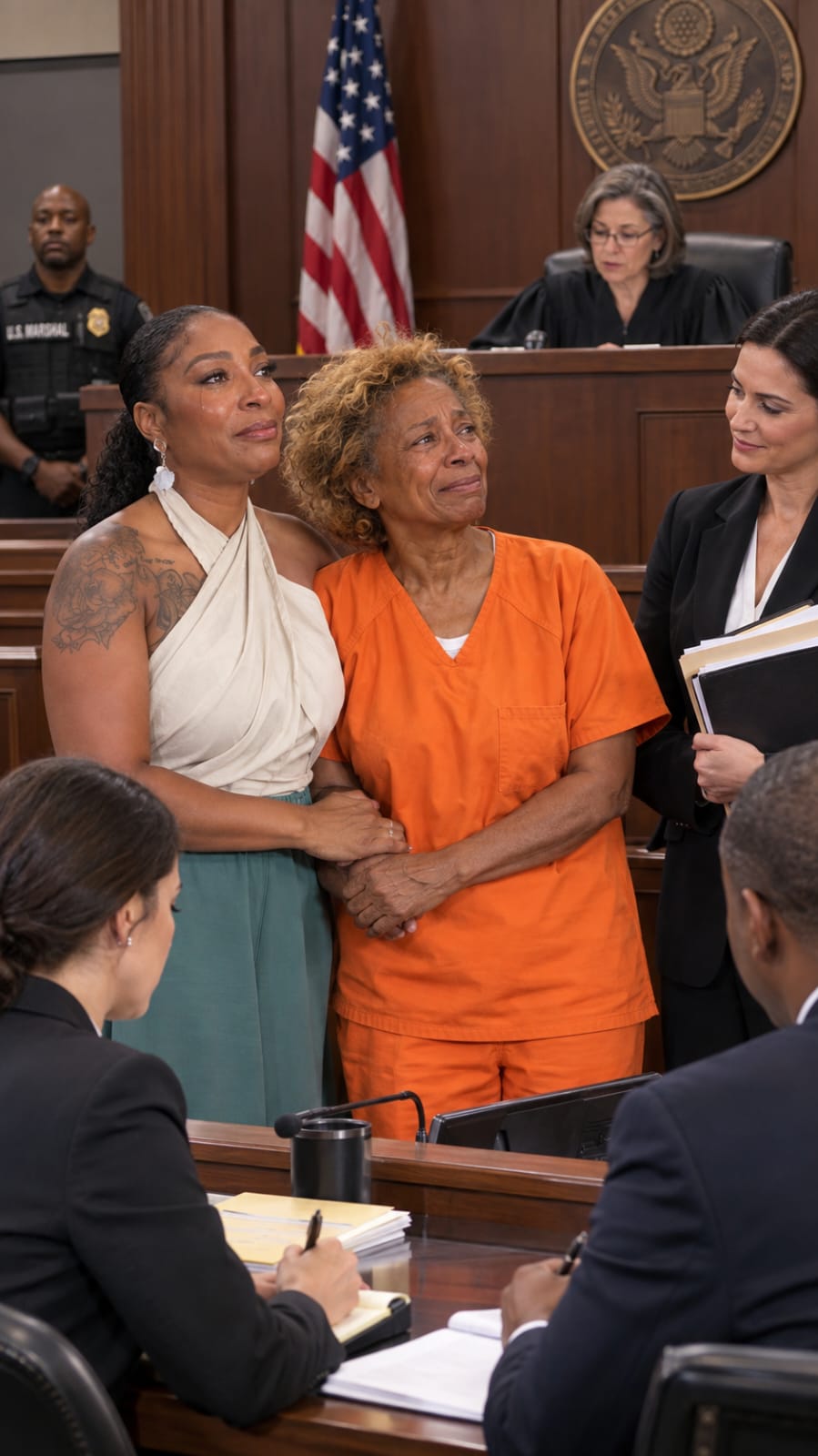
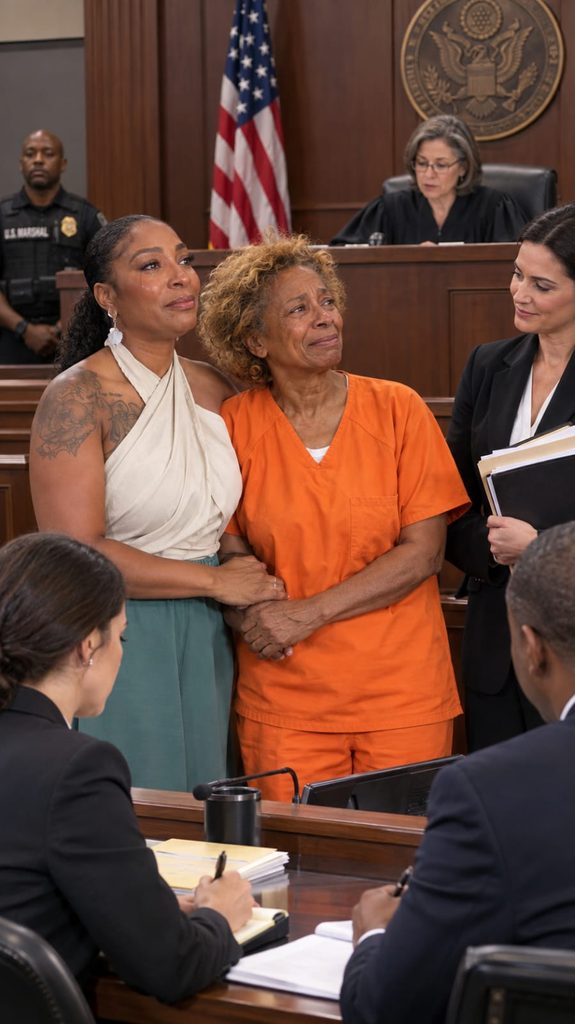
shk ) Sharra held her mother’s hand as the judge delivered a life-changing sentence reduction from the bench.
The Court’s Decision
A Federal Sentence Reduction Hearing
The Courtroom Falls Silent
The federal courtroom had become unusually quiet. Every conversation had stopped as the judge prepared to announce the court’s decision. At the defense table, Sharra stood immediately beside her mother, holding her hand gently. The moment carried enormous emotional weight, but neither woman made a dramatic gesture. The atmosphere remained formal, restrained, and unmistakably serious.
Sharra’s mother had spent years dealing with the consequences of her criminal conviction and custodial sentence. Now the court had reviewed the circumstances surrounding her request for a reduction of the remaining custodial sentence. The decision before the judge was not about erasing the past. It was about whether the documented circumstances justified relief under the applicable federal law.
The Record Before the Judge
Before announcing the ruling, the judge had reviewed the defendant’s documented medical conditions, her age, relevant prison records, the proposed release plan, the defense attorney’s arguments, and the government’s response. The court also considered the sentencing factors required by federal law.
Nothing about the proceeding was treated casually. The judge emphasized that the decision rested upon the information properly presented to the court and the legal standards governing sentence reduction. The defense attorney stood beside Sharra and her mother with a legal folder containing the supporting documentation.
The Ruling
The judge looked toward the defendant and then toward the attorneys before beginning the ruling. Her voice remained calm and measured. There was no theatrical pause and no exaggerated declaration. Instead, the judge formally stated that, after considering the required legal factors, the defendant’s motion for a reduction of the remaining custodial sentence was GRANTED.
The courtroom remained silent as the meaning of the ruling settled over the defense table. The judge explained that the defendant would be released from custody subject to legally authorized conditions of supervised release.
Sharra’s fingers tightened gently around her mother’s hand. Tears appeared in her eyes. She was visibly relieved, but she remained composed as the judge continued explaining the conditions attached to the decision.
Release Does Not Erase the Conviction
The judge made one point especially clear: the release did not erase the defendant’s conviction and did not terminate the underlying criminal case. The defendant would remain subject to the court’s continuing jurisdiction and to every applicable condition imposed through the written order.
The judge explained that freedom from the remaining custodial portion of the sentence did not mean freedom from legal obligations. Supervised release would carry its own requirements, and the defendant would be expected to comply with those requirements carefully.
Her mother listened closely. Her expression showed gratitude, but also an understanding that this was not the end of her legal responsibilities. The courtroom’s atmosphere remained formal as the judge continued through the conditions one by one.
Sharra’s Role
The judge then addressed the approved release plan and Sharra’s role in her mother’s transition from custody. Sharra could serve as her mother’s family support person under the approved plan.
The judge explained that Sharra’s responsibilities would involve providing stable family support and helping her mother remain organized with medical appointments, supervision requirements, and court obligations.
The judge carefully clarified that Sharra was not personally guaranteeing payment of the federal sentence and did not automatically receive legal authority over her mother simply because she was serving as a family support person.
The Conditions of Supervision
The judge next explained the reporting requirements. The defendant would be required to report to the designated U.S. Probation Office or another specifically designated reporting location according to the written conditions of supervised release.
For the purposes of this fictional case, the court’s conditions provided that she would report on the first business day of each month. She would also be required to appear at court proceedings whenever ordered and remain compliant with applicable supervision and medical requirements.
The judge emphasized that these requirements were not optional. Compliance would remain an important part of the defendant’s transition into the community.
A Warning From the Bench
The judge’s tone became slightly firmer as she explained the consequences of failing to comply. The defendant was instructed that violations of supervised release conditions could result in additional court action.
Depending upon the circumstances and applicable law, violations could lead to revocation of supervised release and other consequences authorized by the court. The judge made clear that today’s ruling created an opportunity for release under conditions, not an exemption from future legal obligations.
The defendant nodded slowly. Sharra continued holding her mother’s hand, listening carefully to every word.
The Defense Attorney’s Relief
Beside the two women, the defense attorney remained professional and composed. The attorney held a legal folder containing the medical records, prison records, proposed release plan, and the court’s order.
There was visible relief, but the attorney did not celebrate. The proceeding was still a federal court hearing, and the seriousness of the conditions remained clear. The attorney quietly reviewed the documents again, preparing to make sure the defendant and her family understood what would happen next.
The Government Table
At the government table, the Assistant U.S. Attorney listened carefully and took notes throughout the ruling. There was no dramatic reaction. The government’s position had been presented to the court, and the judge had considered the government’s response as part of the complete record.
Nearby, the federal court clerk continued recording the proceedings. A U.S. Marshal remained naturally visible within the courtroom, maintaining the ordinary security presence expected during a federal proceeding.
A Mother’s Moment
When the judge finished explaining the order, Sharra’s mother finally allowed her emotions to show. Her eyes became wet, and she looked toward her daughter with deep gratitude.
Sharra stood close beside her. Tears remained in her eyes, but her expression was determined rather than overwhelmed. She knew the ruling brought an important change, but she also understood that her mother still had responsibilities to meet.
For the first time in a long time, the two women could think about what came next rather than only what had already happened.
The Written Order
The judge’s written order would formally document the sentence reduction and the conditions governing supervised release. The courtroom remarks were consistent with the written decision and were presented in a restrained, professional manner.
There was no statement that “bail was granted.” Instead, the judge formally announced that the motion for sentence reduction was granted and that the defendant would be released subject to specified conditions of supervised release.
The distinction mattered. The defendant’s conviction remained intact, the underlying case continued to have legal significance, and compliance with the conditions would remain essential.
Walking Toward a New Chapter
As the hearing concluded, Sharra and her mother remained together. The defense attorney gathered the documents while the clerk completed the necessary courtroom work.
Sharra’s mother took a slow br
Leave a Reply