
azm ) Bethany’s Devotion: Larry’s Muscle Weakness Diagnosis, the Doctor’s Prescribed Medicine, and Their Hopeful Journey Toward Recovery, Renewed Strength, and Lasting Love
A story of care, patience & connection
Shadows in the Sanctuary
Sometimes, understanding is the first step toward healing.
The Quiet Distance
The warm glow of the bedside lamp cast long, soft shadows across the master bedroom. It was a Friday night, the kind of quiet, uncluttered evening that Bethany had been anticipating for weeks. She sat on the edge of the mattress, adjusting the folds of her nightgown, listening to the monotonous hum of the ceiling fan.
For months, an invisible wall had been steadily growing between her and Larry. Their relationship had always been built on mutual affection, shared laughter, and a strong physical connection. But over the past year, that vital spark had gently faded into a quiet routine. They lived together like harmonious roommates, sharing meals, managing household chores, and exchanging polite kisses before leaving for work, but the deeper intimacy—the physical closeness that once anchored them—had completely evaporated.
Bethany took a deep breath, building up her courage. She looked over at Larry, who was sitting on his side of the bed, absently scrolling through his phone with a fatigued expression on his face.
“Larry,” Bethany began softly, her voice carrying a mix of vulnerability and hope. “Do you realize how long it’s been since we last had any real intimacy? We haven’t had a physical relationship in months. Come on, let’s make tonight special. Let’s bring back that connection we used to have.”
Larry didn’t immediately look up. His eyes stayed glued to the glass screen of his smartphone. A heavy silence filled the room, punctuated only by the soft tap of his thumb against the glass. He simply brushed off her comment with a quiet murmur.
“I’m just tired, Bethany. It’s been a long week at work,” he muttered, shifting his body slightly away from her and pulling the blanket up to his chest.
Bethany felt a slight sting of rejection, but she was not ready to give up so easily. She shifted closer to him, laying her hand gently on his arm. She smoothed his hair and whispered words of affection, trying to reignite the warmth that seemed to have gone cold. She gently coaxed him, leaning in and asking him to reconsider, expressing how much she missed feeling close to him.
“Please, Larry,” she pleaded gently. “It’s not just about physical desire. It’s about us. I miss feeling connected to you.”
Despite her persistence and emotional appeal, Larry’s reaction remained unchanged. He grew quiet, visibly uncomfortable, and pulled further back into his shell. He gently moved her hand away, keeping his gaze fixed on the wall ahead.
“Not tonight, Bethany. I just don’t have it in me,” he said firmly, his tone flat and devoid of warmth.
Seeing him completely unresponsive and distant, Bethany realized that pushing any further would only create resentment. She pulled back, turned off her nightstand light, and lay in the dark. As Larry’s breathing slowed into sleep, Bethany lay awake, her mind racing with questions.
She knew Larry loved her; there was no doubt about his emotional loyalty. So why was he withdrawing so completely from physical intimacy? Was he stressed? Was he emotionally detached? Or was there something deeper happening within his body that he wasn’t talking about?
The Unseen Burden
Over the next few days, Bethany began observing Larry with closer attention. Away from the pressure of the bedroom, she noticed subtle signs she had previously overlooked. Larry moved with a subtle hesitation. Simple daily tasks seemed to drain his energy unnaturally. Opening a tightly closed jar in the kitchen made his hands tremble slightly. Walking up the stairs to their second-floor bedroom left him unusually winded, and he frequently complained of lingering soreness in his lower back and legs, even though he hadn’t engaged in any heavy manual labor.
When she observed him trying to lift a box of books from the hallway closet, she saw his arms shake under a weight he used to carry effortlessly. The realization struck her like a flash of clarity: Larry wasn’t merely ignoring her out of emotional disinterest or coldness. He was physically exhausted, experiencing a profound loss of strength that he was likely too proud—or too confused—to admit.
That evening, Bethany sat Larry down in the living room. Instead of approaching the topic from a angle of relationship frustration, she approached it with care and concern for his well-being.
“Larry,” she said softly, holding his hands in hers. “I’m not angry about the other night, but I am worried about you. I’ve been watching you lately. You look exhausted all the time. You’re struggling with tasks that used to be easy for you, and your body seems weak. I think we need to go see a doctor.”
Larry initially resisted, his pride coming up as a defense mechanism. “I’m fine, Bethany. It’s just stress from work and getting older. I don’t need a doctor.”
“If you’re fine, then a quick checkup won’t hurt,” Bethany insisted gently, leaving no room for refusal. “I love you, and I want to make sure your body is healthy. Please, do this for me—and for yourself.”
Realizing how deeply concerned she was, and perhaps secretly aware of his own physical decline, Larry finally relented and nodded.
The Medical Evaluation
Bethany scheduled an appointment with a specialist—a physician focused on neuromuscular health and muscular physiology.
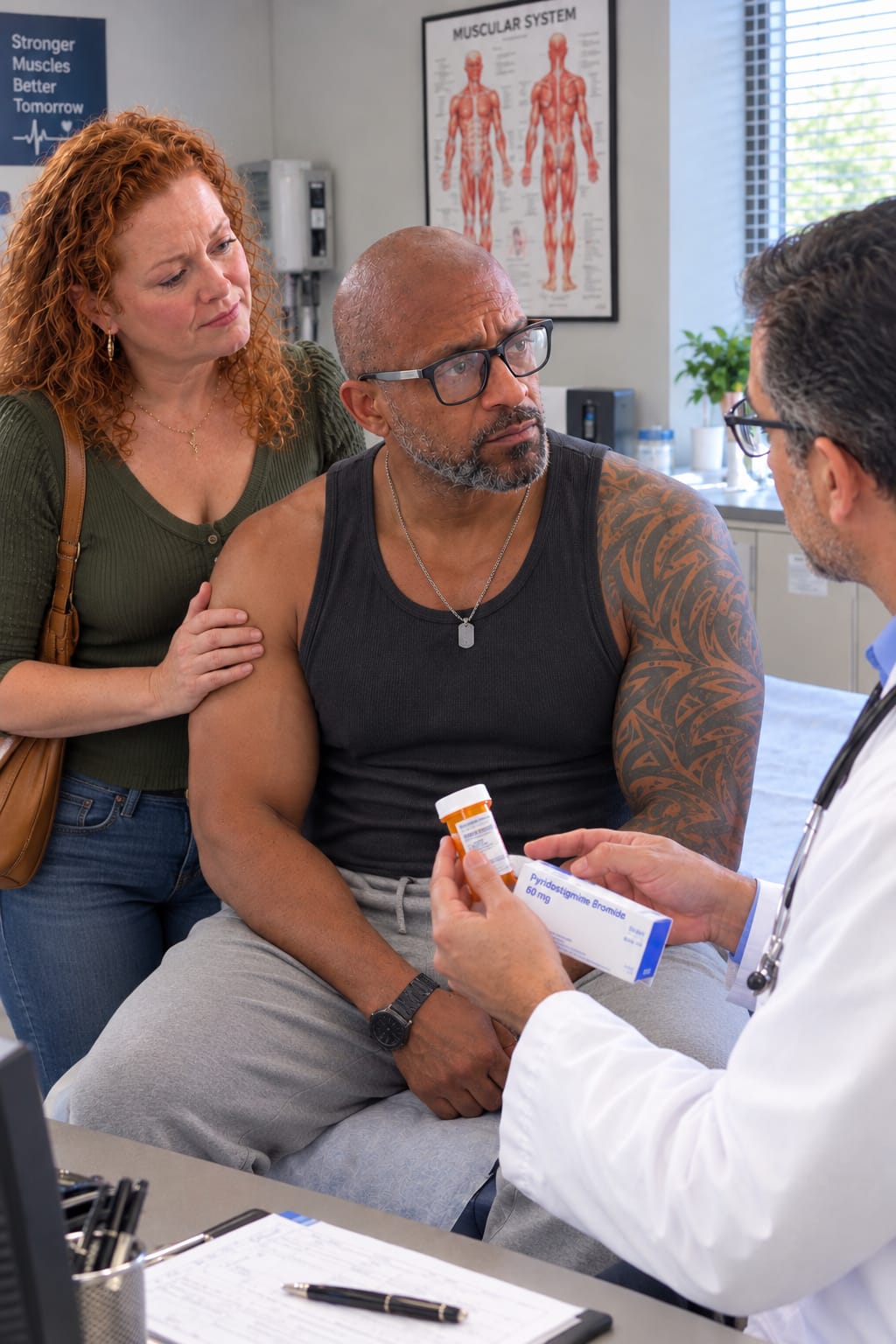
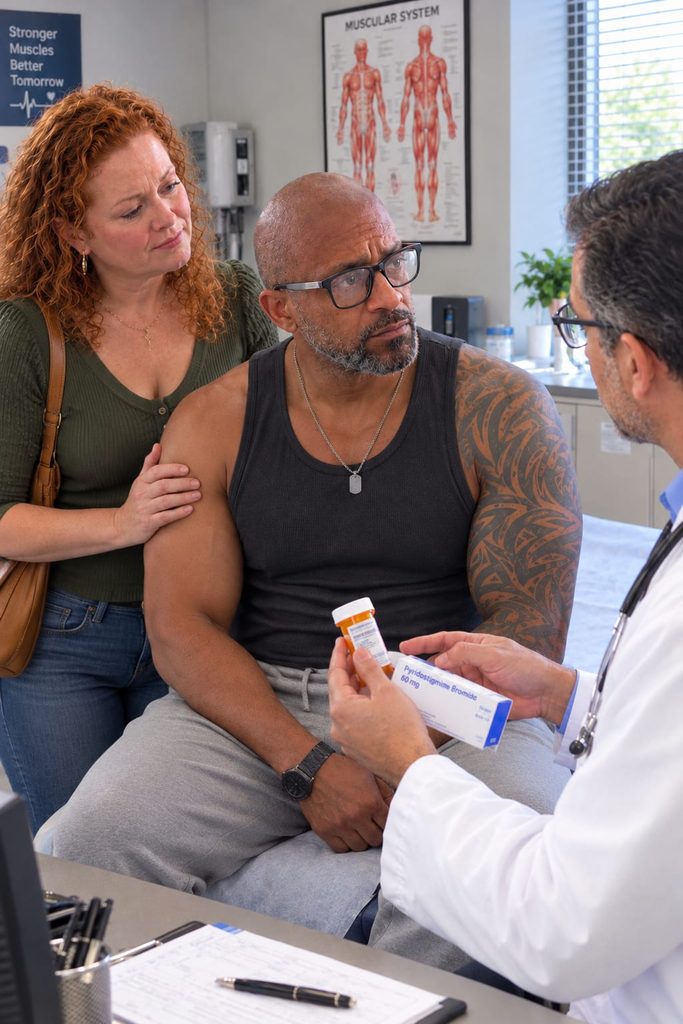
A few days later, they sat together in the sterile, brightly lit consultation room of the clinic. The doctor, a calm and methodical specialist named Dr. Miller, listened attentively as Bethany explained the symptoms she had observed: chronic fatigue, loss of stamina, muscle tremors during basic exertion, and an overall lack of physical energy. Larry spoke candidly as well, admitting that he had felt his physical vitality steadily draining away over the past several months, leaving him feeling drained both during the day and at night.
Dr. Miller nodded thoughtfully and proceeded with a comprehensive physical exam. He checked Larry’s reflexes, measured his muscle tone, evaluated his grip strength, and conducted a series of basic mobility tests. He also ordered a panel of blood tests to evaluate nutrient levels, hormone balances, and markers of muscle tissue recovery.
After reviewing the preliminary test results and physical observations, Dr. Miller sat back in his chair and addressed the couple.
“Well, Larry,” Dr. Miller began in a reassuring tone, “the good news is that you are not suffering from any degenerative neurological disease. However, your symptoms are very real. You are dealing with severe muscle weakness and localized neuromuscular exhaustion, likely brought on by a combination of nutritional deficiencies, poor muscular recovery, and prolonged stress.”
Larry looked up, surprised. “Muscle weakness? Is that why I feel so tired all the time?”
“Precisely,” Dr. Miller explained. “Muscles require a delicate balance of specific nutrients, proper circulation, and sufficient recovery time to function properly. When your muscles lack essential compound nutrients and stamina-building blocks, even basic physical tasks require twice as much energy. This leads to generalized fatigue, low stamina, and a complete lack of physical vigor. It affects your daily energy, your mood, and naturally, your physical intimacy as well. Your body simply hasn’t had the physiological strength to support high-energy activities.”
Bethany looked at Larry, her heart softening as she realized that his reluctance had been a physical limitation rather than a lack of affection.
“What do we need to do doctor?” Bethany asked eagerly. “How do we help him get his strength back?”
The Path to Recovery
Dr. Miller smiled warmly, opening his prescription pad. “This is entirely treatable, but it requires patience and strict discipline. I am going to prescribe a course of targeted medications designed to rebuild muscle fiber integrity, improve cellular energy production, and restore systemic stamina.”
He wrote down a carefully structured medical regimen. He prescribed specialized micronutrient supplements to rebuild muscle tissue, along with therapeutic daily medications aimed at improving muscular circulation and reducing chronic fatigue.
“Larry,” Dr. Miller emphasized, looking him directly in the eye, “you must take these medications exactly as prescribed—every single day, without skipping doses. In addition to the prescription, I want you to make three commitment changes: drink plenty of water, follow a high-protein diet to assist muscle repair, and engage in very light, daily stretching exercises to improve blood flow. Do not push yourself too hard at first. Let the medicine and rest do their work.”
“I understand, Doctor,” Larry replied, holding the prescription in his hand. For the first time in months, a glimmer of relief was visible on his face. The weight of his unsaid physical struggle had finally been lifted by a clear diagnosis.
They left the clinic with a clear plan. On the way home, Bethany stopped at the pharmacy to collect the prescribed medications. When they arrived back at their house, she set up a small organizer on the kitchen counter, placing the pill bottles neatly where Larry would see them every morning and evening.
“We are in this together,” Bethany said, handing him his first dose along with a glass of water. “No pressure, no stress. We focus on your health first.”
Larry swallowed the medication and drew Bethany into a warm, genuine hug. “Thank you for not giving up on me,” he whispered softly. “I was ashamed of feeling so weak, but I’m glad you pushed me to get help.”
A New Chapter
The recovery process did not happen overnight, but week by week, the changes became evident.
Following Dr. Miller’s strict instructions, Larry took his medications consistently every day. Bethany supported him by preparing nutrient-dense meals and encouraging him during his daily light exercises. By the third week, the constant exhaustion that had clouded Larry’s eyes began to lift. His grip became stronger, his walk lighter, and he no longer struggled with simple household tasks.
With his physical strength returning, his confidence restored as well. The heavy cloud of frustration and fatigue that had hung over their home gradually dissolved, replaced by smiles, shared laughter, and meaningful conversations.
One evening, a little over a month after their visit to the doctor, Bethany walked into the living room after finishing her evening routine. Larry was standing by the window, looking refreshed and relaxed.
When she approached, he turned toward her, reaching out his hands to wrap them gently around her waist. His touch was warm, firm, and filled with a vitality that had been missing for far too long.
“You look beautiful tonight,” Larry said softly, gazing into her eyes with genuine warmth and energy.
Bethany smiled, leaning into his embrace, feeling the solid strength in his shoulders and the steady beat of his heart. The barrier that had once stood between them was finally gone—not through force or frustration, but through understanding, care, and the right medical support.
Hand in hand, they walked toward their bedroom, ready to start a healthier, stronger, and more connected chapter of their lives together.
Leave a Reply