
Road And Traffic Signs 2
What does this sign mean?
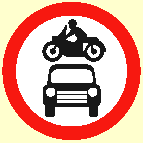
A sign will indicate which types of vehicles are prohibited from certain roads. Make sure that you know which signs apply to the vehicle you’re using.
You’re on a motorway. A lorry has stopped in the right-hand lane. What should you do when you see this sign on the lorry?

Sometimes work is carried out on the motorway without closing the lanes. When this happens, signs are mounted on the back of lorries to warn other road users of the roadworks ahead.
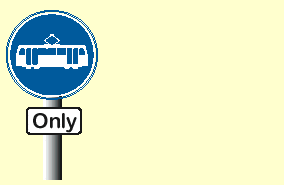
What does this sign mean?
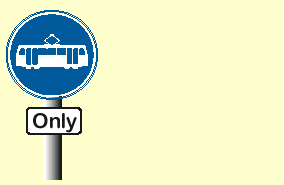
Avoid blocking tram routes. Trams are fixed on their route and can’t manoeuvre around other vehicles or pedestrians. Modern trams travel quickly and are quiet, so you might not hear them approaching.
What does this sign mean?

These signs are often seen in one-way streets that have more than one lane. When you see this sign, use the route that’s the most convenient and doesn’t require a late change of direction.
What shape is a ‘stop’ sign at a junction?
To make it easy to recognise, the ‘stop’ sign is the only sign of this shape. You must stop and take effective observation before proceeding.
You’re approaching a red traffic light. What will the signal show next?
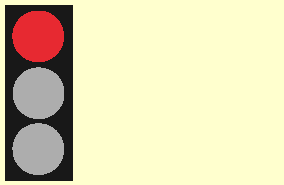
If you know which light is going to show next, you can plan your approach accordingly. This can help prevent excessive braking or hesitation at the junction.
What does the white line along the side of the road indicate?

A continuous white line is used on many roads to indicate the edge of the carriageway. This can be useful when visibility is restricted. The line is discontinued at junctions, lay-bys, and entrances to or exits from private drives.
What does this sign mean?

Urban clearways are provided to keep traffic flowing at busy times. You may stop only briefly to set down or pick up passengers. Times of operation will vary from place to place, so always check the signs.
Advertisement
ArrayWhy should you make sure that your indicators are cancelled after turning?
Leaving your indicators on could confuse other road users and may even lead to a crash. Be aware that if you haven’t taken a sharp turn, your indicators may not self-cancel and you’ll need to turn them off manually.
What does a circular traffic sign with a blue background do?

Signs with blue circles mostly give a positive instruction. These are often found in urban areas and include signs for mini-roundabouts and directional arrows.
What does a circular traffic sign with a blue background do?

Signs with blue circles mostly give a positive instruction. These are often found in urban areas and include signs for mini-roundabouts and directional arrows.
What does this sign mean?

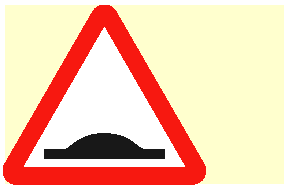
If you’re in a place where there are likely to be pedestrians (for example, outside a school, near a park, in a residential area or in a shopping area), you should be cautious and keep your speed down. Many local authorities have taken steps to slow traffic down by creating traffic-calming measures such as speed humps. They’re there for a reason; slow down.
You see this signal overhead on the motorway. What does it mean?

You’ll see this sign if there has been an incident ahead and the motorway is closed. You must obey the sign. Make sure that you prepare to leave in good time. Don’t cause drivers to take avoiding action by cutting in at the last moment.
What does this sign mean?

Yellow-and-black temporary signs may be used to inform you about roadworks or lane restrictions. Look well ahead. If you have to change lanes, do so in good time.
What does this sign mean?

You might see this sign where traffic lights are out of order. Proceed with caution, as nobody has priority at the junction.
When may you sound the horn?
Never sound the horn aggressively. You mustn’t sound it when driving in a built-up area between 11.30 pm and 7.00 am, or when you’re stationary, unless another road user poses a danger. Don’t scare animals by sounding your horn.
Where would you see a contraflow bus and cycle lane?
The traffic permitted to use a contraflow lane travels in the opposite direction to traffic in the other lanes on the road.
What does this sign mean?

As you approach a roundabout, look well ahead and check all signs. Decide which exit you wish to take and move into the correct position as you approach the roundabout, signalling as required.
What does this white arrow on the road ahead mean?

Don’t attempt to overtake here, as there might be unseen hazards over the brow of the hill. Keep to the left.
You see this amber traffic light ahead. Which light, or lights, will come on next?

At junctions controlled by traffic lights, you must stop behind the white line until the lights change to green. A red light, an amber light, and red and amber lights showing together all mean stop. You may proceed when the light is green unless your exit road is blocked or pedestrians are crossing in front of you. If you’re approaching traffic lights that are visible from a distance and the light has been green for some time, be ready to slow down and stop, because the lights are likely to change.
Which of these signs means the end of a dual carriageway?
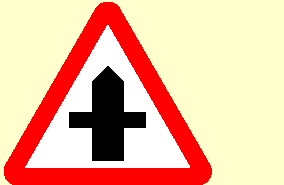
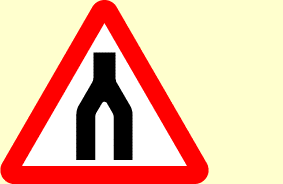
If you’re overtaking, make sure you move back safely into the left-hand lane before you reach the end of the dual carriageway.
Which shape is used for a ‘give way’ sign?


Other warning signs are the same shape and colour, but the ‘give way’ triangle points downwards. When you see this sign, you must give way to traffic on the road that you’re about to enter.
Which is the sign for a ring road?


Ring roads are designed to relieve congestion in towns and city centres.
What does this sign mean?
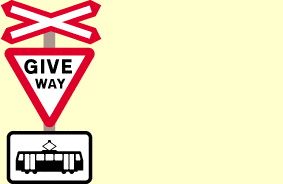
Obey the ‘give way’ signs. Trams are unable to steer around you if you misjudge when it’s safe to enter the junction.
Which of these is a hazard warning line?
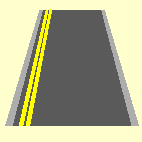


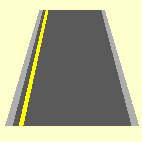
You need to know the difference between the normal centre line and a hazard warning line. If there’s a hazard ahead, the markings are longer and the gaps shorter. This gives you advance warning of an unspecified hazard.
What should you do when approaching traffic lights where red and amber are showing together?

Be aware that other traffic might still be clearing the junction as you approach. A green light means you may go on, but only if the way is clear.
What does this sign mean?
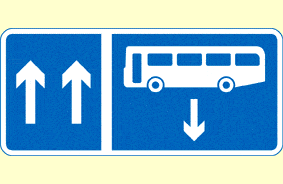
There will also be markings on the road surface to indicate the bus lane. You mustn’t use this lane for parking or overtaking.
What does this sign mean?

Some crossings have gates but no attendant or signals. You should stop, look both ways, listen and make sure that no train is approaching. If there’s a telephone, contact the signal operator to make sure it’s safe to cross.
How can you identify traffic signs that give orders?
There are three basic types of traffic sign: those that warn, those that inform and those that give orders. Generally, triangular signs warn, rectangular signs give information or directions, and circular signs give orders. An exception is the eight-sided ‘stop’ sign.
What does this sign indicate?
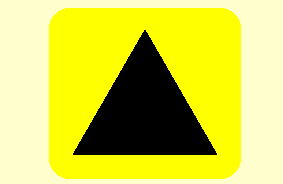
When a diversion route has been put in place, drivers are advised to follow a symbol, which may be a black triangle, square, circle or diamond shape on a yellow background.
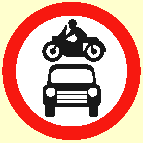
Which sign means no motor vehicles allowed?
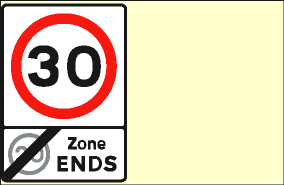

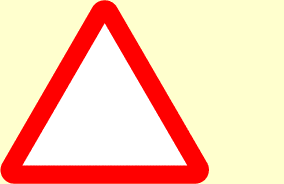
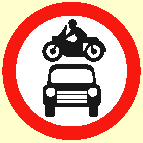
This sign is used to enable pedestrians to walk free from traffic. It’s often found in shopping areas.
What does this sign mean?
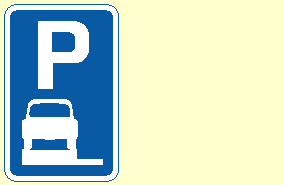
In order to keep roads free from parked cars, there are some areas where you’re allowed to park on the verge. Only do this where you see the sign. Parking on verges or footways anywhere else could lead to a fine.
What does this sign mean?

This sign shows you that you can’t get through to another route by turning left at the junction ahead.
What’s the reason for the area marked in red and white along the center of this road?

Areas of ‘hatched markings’ such as these separate traffic streams that could be a danger to each other. They’re often seen on bends or where the road becomes narrow. If the area is bordered by a solid white line, you mustn’t enter it except in an emergency.
You’re on a motorway. Red flashing lights appear above your lane only. What should you do?
Flashing red lights above your lane show that your lane is closed. You should move into another lane as soon as you can do so safely.
These flashing red lights mean that you must stop. Where would you find them?

These signals are found at level crossings, swing or lifting bridges, some airfields and emergency access sites. The flashing red lights mean stop whether or not the way seems to be clear.
Where would you find these road markings?

These markings show the direction in which the traffic should go at a mini-roundabout.
At a junction, you see this sign partly covered by snow. What does it mean?

The ‘stop’ sign is the only road sign that’s octagonal. This is so that it can be recognised and obeyed even if it’s obscured (for example, by snow).
What does this sign mean?

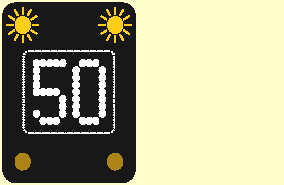
Temporary restrictions on motorways are shown on signs that have flashing amber lights. At the end of the restriction, you’ll see this sign without any flashing lights.
What does this sign mean?

You’ll need to slow down. At hump bridges, your view ahead will be restricted and the road will often be narrow. If the bridge is very steep, sound your horn to warn others of your approach. Going over the bridge too fast is highly dangerous to other road users and could even cause your wheels to leave the road, with a resulting loss of control.
You’re approaching a junction where the traffic lights aren’t working. What should you do when a police officer gives this signal?

When a police officer or traffic warden is directing traffic, you must obey them. They’ll use the arm signals shown in The Highway Code. Learn what these signals mean and obey them.
What does this sign mean?

Don’t wait until the last moment before moving into the left-hand lane. Plan ahead and don’t rely on other traffic letting you in.
Where can you find reflective amber studs on a motorway?
At night or in poor visibility, reflective studs on the road help you to judge your position on the carriageway.
What does this sign mean?

Be prepared for traffic approaching from junctions on either side of you. Try to avoid unnecessary changing of lanes just before the junction.
How should you give an arm signal to turn left?


There may be occasions when other road users are unable to see your indicator, such as in bright sunlight or at a busy, complicated junction. In these cases, an arm signal will help others to understand your intentions.
Where would you see these road markings?

When driving on a motorway or slip road, you mustn’t enter an area marked with chevrons and bordered by a solid white line for any reason, except in an emergency.
Which of these signs means there’s a double bend ahead?


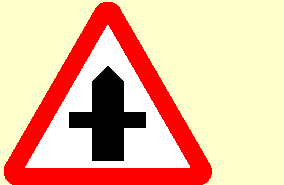
Triangular signs give you a warning of hazards ahead. They’re there to give you time to prepare for the hazard; for example, by adjusting your speed.
What does this sign mean?
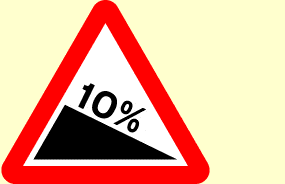
This sign gives you an early warning that the road ahead will slope downhill. Prepare to alter your speed and gear. Looking at the sign from left to right will show you whether the road slopes uphill or downhill.
Share your Results: