
Vehicle Handling 2
What should you do when there’s been a heavy fall of snow?
Consider whether the increased risk is worth it. If the weather conditions are bad and your journey isn’t essential, then don’t drive.
After this hazard you should test your brakes. Why is this?

A ford is a crossing over a stream that’s shallow enough to drive or ride through. After you’ve gone through a ford or deep puddle, your brakes will be wet and they won’t work as well as usual. To dry them out, apply a light brake pressure while moving slowly. Don’t travel at normal speeds until you’re sure your brakes are working properly again.
You’re driving on a well-lit motorway on a clear night. What must you do?
If you’re driving on a motorway at night or in poor visibility, you must always use your headlights, even if the road is well lit. Other road users must be able to see you, but you should avoid causing dazzle.
Daytime visibility is poor but not seriously reduced. Which lights should you switch on?
Only use your fog lights when visibility is seriously reduced. Use dipped headlights in poor conditions because this helps other road users to see you without the risk of causing dazzle.
You’re driving on a motorway at night. When may you switch off your headlights?
Always use your headlights at night on a motorway unless you’ve had to stop on the hard shoulder. If you break down and have to use the hard shoulder, switch off your headlights but leave your sidelights on, so that other road users can see your vehicle.
What should you do when dealing with this hazard?

In normal conditions, a ford can be crossed quite safely by driving through it slowly. The water may affect your brakes, so when you’re clear of the ford, test them before you resume normal driving.
What do traffic-calming measures do?
Traffic-calming measures make the roads safer for vulnerable road users, such as cyclists, pedestrians and children. These can be designed as chicanes, road humps or other obstacles that encourage drivers and riders to slow down.
Why is travelling in neutral for long distances (known as coasting) wrong?
Try to look ahead and read the road. Plan your approach to junctions and select the correct gear in good time. This will give you the control you need to deal with any hazards that occur. You’ll coast a little every time you change gear. This can’t be avoided, but it should be kept to a minimum.
Advertisement
ArrayYou’re driving down a long, steep hill. You suddenly notice that your brakes aren’t working as well as normal. What’s the usual cause of this?
This is more likely to happen on vehicles fitted with drum brakes, but it can apply to disc brakes as well. Using a lower gear will assist the braking and help you to keep control of your vehicle.
Which of these plates normally appears with this road sign?
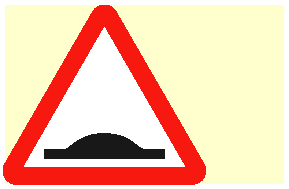


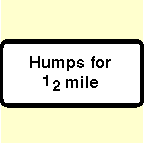

Road humps are used to slow down traffic. They’re found in places where there are often pedestrians, such as shopping areas, near schools, and residential areas. Watch out for people close to the kerb or crossing the road.
What will happen if you hold the clutch pedal down or roll in neutral for too long?
Holding the clutch down or staying in neutral for too long will cause your vehicle to freewheel. This is known as ‘coasting’ and it’s dangerous because it reduces your control of the vehicle.
What will affect your vehicle’s stopping distance?
Having tyres correctly inflated and in good condition will ensure they have maximum grip on the road; how well your tyres grip the road has a significant effect on your car’s stopping distance.
What’s a rumble device designed to do?
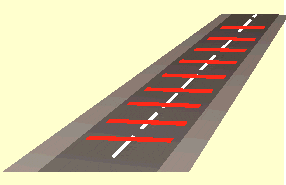
A rumble device consists of raised markings or strips across the road, designed to give drivers an audible, visual and tactile warning. These devices are used in various locations, including in the line separating the hard shoulder and the left-hand lane on the motorway and on the approach to some hazards, to alert drivers to the need to slow down.
You’re driving on an icy road. What distance from the car in front should you drive?
Don’t travel in icy or snowy weather unless your journey is essential. Drive extremely carefully when roads are or may be icy. Stopping distances can be ten times greater than on dry roads.
You’re braking on a wet road. Your vehicle begins to skid. It doesn’t have anti-lock brakes. What’s the first thing you should do?
If the skid has been caused by braking too hard for the conditions, release the brake. You may then need to reapply and release the brake again. You may need to do this a number of times. This will allow the wheels to turn and so some steering should also be possible.
Why is it bad technique to coast when driving downhill?
Coasting is when you allow the vehicle to freewheel in neutral or with the clutch pedal depressed. Speed will increase as you lose the benefits of engine braking and have less control. You shouldn’t coast, especially when approaching hazards such as junctions or bends and when travelling downhill.
While you’re driving in fog, it becomes necessary to use front fog lights. What should you remember?
It’s illegal to use your fog lights in conditions other than when visibility is seriously reduced; that is, less than 100 metres (328 feet). Fog lights are very bright and, if you use them when visibility has improved, you could dazzle other drivers.
You’re driving down a steep hill. Why could it be dangerous to keep the clutch down or roll in neutral for too long?
Driving in neutral or with the clutch down for long periods is known as ‘coasting’. There will be no engine braking and your vehicle will pick up speed on downhill slopes. Coasting can be very dangerous because it reduces steering and braking control.
What can fitting chains to your wheels help to prevent?
Chains can be fitted to your wheels in snowy conditions. They can help you to move off without wheelspin, or to keep moving in deep snow. You’ll still need to adjust your driving to suit these conditions.
You have to make a journey in fog. What should you do before you set out?
If you have to drive in fog, switch your dipped-beam headlights on and keep your windscreen clear. You should always be able to pull up within the distance you can see ahead.
What must you do when overtaking a car at night?
To prevent your lights from dazzling the driver of the car in front, wait until you’ve passed them before switching to full beam.
Share your Results: